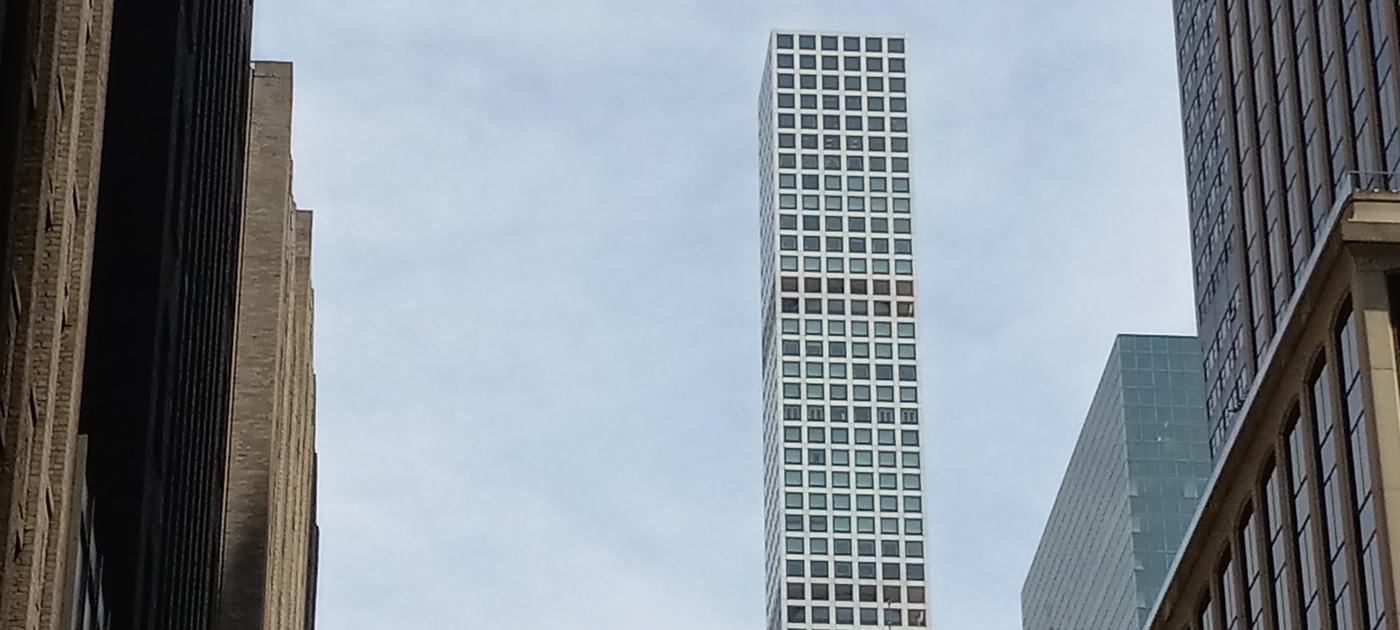
In 2015, the tallest residential building in the Western Hemisphere opened on Park Avenue between 56th and 57th. 1,396 feet, 96 floors, and a façade designed by Rafael Viñoly to look — in his own words — like the white waste basket on his desk.
The buyers showed up anyway.
Jennifer Lopez and Alex Rodriguez paid $15.3 million for unit 76B. A Saudi retail magnate paid $87.7 million for the penthouse. The building's combined sales topped $2 billion before the ribbon was cut. Tabloid coverage ran for two years.
Then the residents started complaining.
The condo board sued the developers in 2021 for $125 million, citing more than 1,500 construction and design defects. A second action filed in 2025 expanded the claim. The original complaint, filed in New York State Supreme Court, described elevators that stalled mid-ride for hours, pipes that burst and flooded multiple floors, and a trash chute that — per the filing — "sounded like a bomb" every time a resident upstairs dropped a bag. The complaint cited swaying severe enough at the top floors to disrupt daily life.
The receipts went viral online: burst pipe photos, elevator outage logs, board meeting transcripts. One specific incident sits in the public record. On October 31, 2019, a resident was stuck in an elevator of the 85-story tower for nearly 90 minutes during high winds. In 2018, a leak at a mechanical floor took two elevators out of service for weeks and reportedly damaged 35 apartments. Per the lawsuit, the building's insurance costs jumped roughly 300% in two years on the back of two 2018 water incidents that produced $9.7 million in covered losses. A study commissioned by residents and cited in the lawsuit found roughly 73% of the building's mechanical, plumbing, and electrical infrastructure was not built to plans.
The lawsuit catalogues quieter absurdities too.
Per the complaint, developer Harry Macklowe proposed fixing the 30-inch-thick concrete facade with a clear silicone finish — the same material used to seal his yacht.
In one passage, the chairman of co-developer CIM is quoted, in what the filing calls "an unguarded moment," describing the building's noise and vibration as "intolerable" and saying it made it "difficult to sleep during periods of even moderately inclement weather."
At one point, contractors trying to repair one of the tower's chronic plumbing problems drilled into the building's wiring and triggered an explosion that killed power to the building. Residents lost their free breakfasts at the in-house Michelin-star restaurant.
None of it shows up in the place most people would think to look.
What the public record actually says
On Brix, 432 Park Avenue — BBL 1012927502 — scores in the B range. Zero open HPD violations. Zero open DOB violations. The building has 126 residential units across 96 floors. PLUTO records year built as 2012 — when foundation work began — though the first residents moved in in 2015.
The friction lives in a different file: more than 70 separate 311 complaints have been logged against the building. That's the dataset where residents call the city about elevator outages, water leaks, heat issues, and noise — the exact category of grievance the lawsuit catalogued. For a 126-unit building, that volume is not catastrophic. For a building where the cheapest apartment cost $7 million, it's a story.
This is the gap the public record is built around. HPD violations track the rental stock — buildings where tenants need legal protection. DOB violations track unsafe construction the city has formally cited. Neither catches "the trash chute sounds like a bomb." That goes to 311.
If you bought a $15 million apartment at 432 Park in 2015 and only checked HPD before signing, the building looked perfect. Because for HPD's purposes, it was.
Why it happened (the boring version)
Supertalls are a relatively new building type — towers over 1,000 feet on extremely narrow footprints, made structurally possible by tuned mass dampers that fight sway. 432 Park has a particularly extreme aspect ratio: the building is 15 times taller than it is wide. Construction began in 2012; the tower topped out in October 2014; the first residents moved in the following year. The engineering works. The plumbing, mechanical, and elevator systems built into a structure that thin do not always work as advertised, especially at the top, where wind loads are extreme and access for repairs is brutally expensive.
The original 2021 lawsuit moved quietly through the courts; a 2025 filing renewed and expanded the claims. The defects, per court filings, are still being repaired. Engineers cited in the lawsuit and in press reporting have warned that without an estimated $160 million in repairs, pieces of the facade could shed onto the street below. The Department of Buildings, citing its 2023 facade inspection, says the building is currently safe.
What this means for everyone else
This isn't really about supertalls. The dataset the city uses to flag a building isn't the dataset residents use to complain about it, and that's true at 432 Park and at every $3,000 walkup in Bushwick.
A rent-stabilized walkup in Ridgewood with a broken radiator and a bedbug history will have hundreds of 311 complaints filed against it over a decade, while the broker showing it to you talks about the natural light. Same dataset, same gap, same problem. The only difference at 432 Park is the price tag and the press coverage.
If you're considering a building — to rent, to buy, to invest in — the public record splits across at least four agencies, and the one that catches lived-experience friction (311) is rarely the one a broker shows you.
432 Park has zero HPD violations and a $125 million defect lawsuit. Both are true at the same time. The building's record on Brix surfaces the 311 complaints the way it would on a rent-stabilized walkup in Bushwick: same data, same weight, applied to a building most New Yorkers will only ever see from the street.